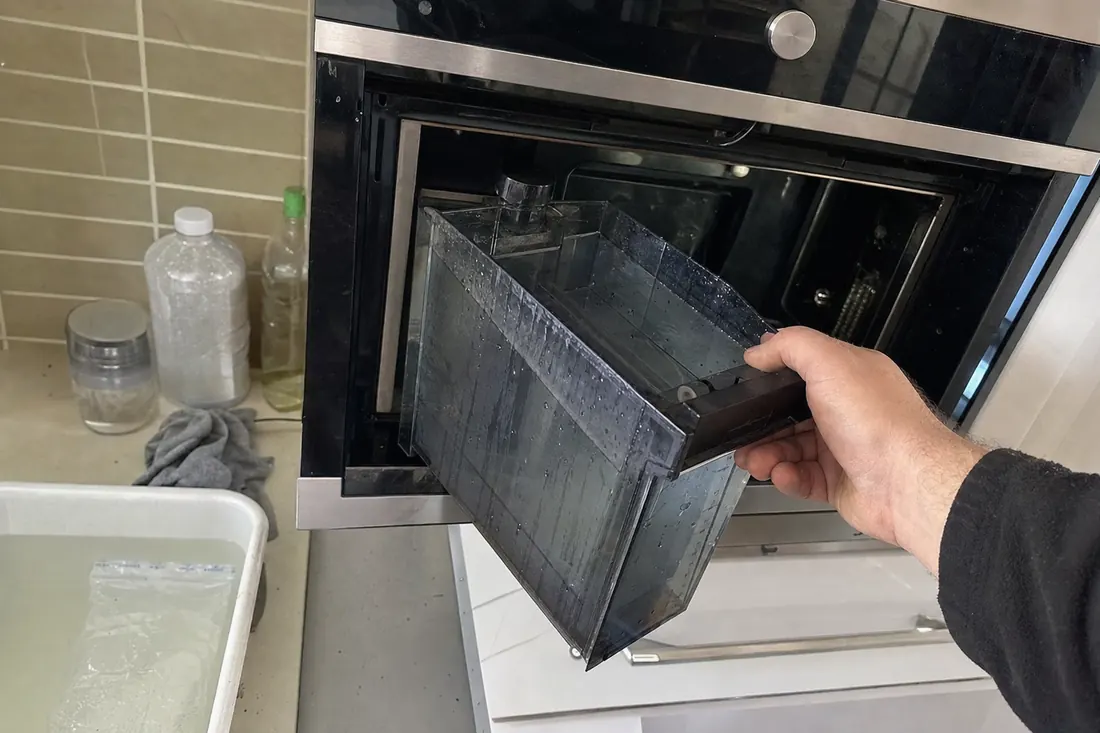
What Bosch actually sells here
Bosch covers dishwashers, wall ovens, slide-in ranges, induction and gas cooktops,
ventilation, and refrigeration in counter-depth and built-in configurations. In
Northeast Florida the dishwasher is far and away what we are called about most,
followed by cooktops and ovens.
There is one design fact about Bosch dishwashers that explains a large fraction of
the service calls in this climate, and it is worth understanding before you decide
anything is broken.
Condensation drying and a humid kitchen
Bosch dishwashers do not use an exposed heating element to bake the load dry. They
use condensation drying: stainless steel tub walls stay cooler than the load, water
vapour migrates to the wall, condenses, and drains away. It is quieter and it uses
much less energy. It also depends on a temperature difference between the load and
the tub.
In a house at 75 percent relative humidity with the dishwasher opened straight
after the cycle, that difference gets consumed by the room. Plastics stay wet.
Homeowners in Jacksonville call this a broken dryer; it is usually physics. Letting
the cycle finish and stand for twenty minutes before opening, keeping the rinse aid
reservoir filled, and loading plastics on the upper rack recovers most of it.
What is not physics: standing water in the sump, a cycle that stops mid-programme,
or a wash that runs cold. Those are real faults, and they need the drain path,
circulation pump and heater circuit checked properly.
Wash results, measured rather than argued about
When a Bosch wash falls off, the useful question is which of the four inputs has
gone: heat, chemistry, time or mechanical energy. Only the last one is visible from
the kitchen, so we measure the others.
Coverage first. Both arms have to turn freely and every jet has to be clear; grit,
seeds and label paper block jets one at a time, and a single blocked jet changes the
pattern across a whole rack. Then fill volume, because a machine filling short
sprays at reduced pressure for the entire cycle, and a restricted inlet or a tired
fill valve does that quietly. Then wash temperature, logged through the cycle rather
than assumed — a wash that never reaches temperature produces precisely the “it
stopped cleaning” complaint, and the cause is normally the heater circuit or a
sensor rather than anything the owner changed.
A tablet still sitting in the dispenser at the end of a cycle narrows it further: the
dispenser did not open, the water was too cool to dissolve it, or the spray never
reached it. Three faults, one symptom, and the estimate is different for each.
Refrigeration, cooktops and ovens
Bosch refrigeration in this region fails mainly at the ice and water path — a fill
tube that freezes back on itself, a slow inlet valve, a filter left in well past its
life restricting flow until the fill never completes.
Induction cooktops that cut out under sustained high power are usually thermal
protection doing its job. The electronics beneath the glass are air-cooled, the
intake is often in a cabinet, and Florida dust plus a warm kitchen narrows the
margin. Clearing the intake path is a genuine repair, not a workaround.
Wall ovens that bake long get measured, not guessed. We probe the cavity through a
full cycle and compare against the set point before deciding whether the sensor,
the calibration or the element is at fault.
How we work on them
A visit is an $80 flat diagnostic, credited toward the repair on approval, followed
by a written estimate before any part is ordered. Genuine OEM parts only, 90 days on
labor and 365 days on parts. If the honest answer is that your dishwasher is working
correctly and the installation or the loading is the problem, that is the answer you
will get.